
How Much Does ASC Billing Cost in 2026: Fees by Monthly Collections and Specialty
What surgery centers pay billing companies: survey bands, what the percentage is charged on, how collections and specialty move it, and published rate cards.
November 10, 2026 · 13 min read
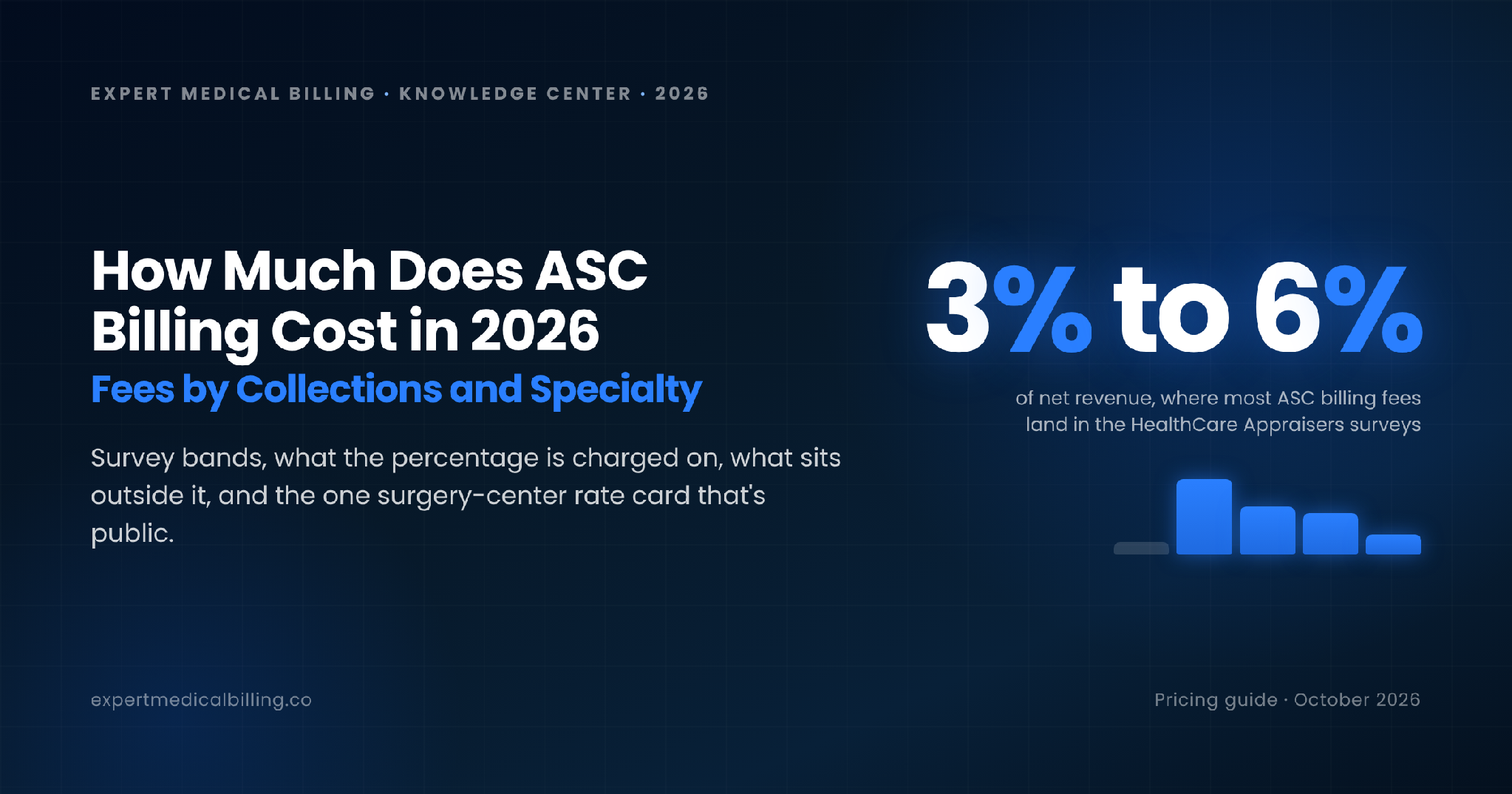
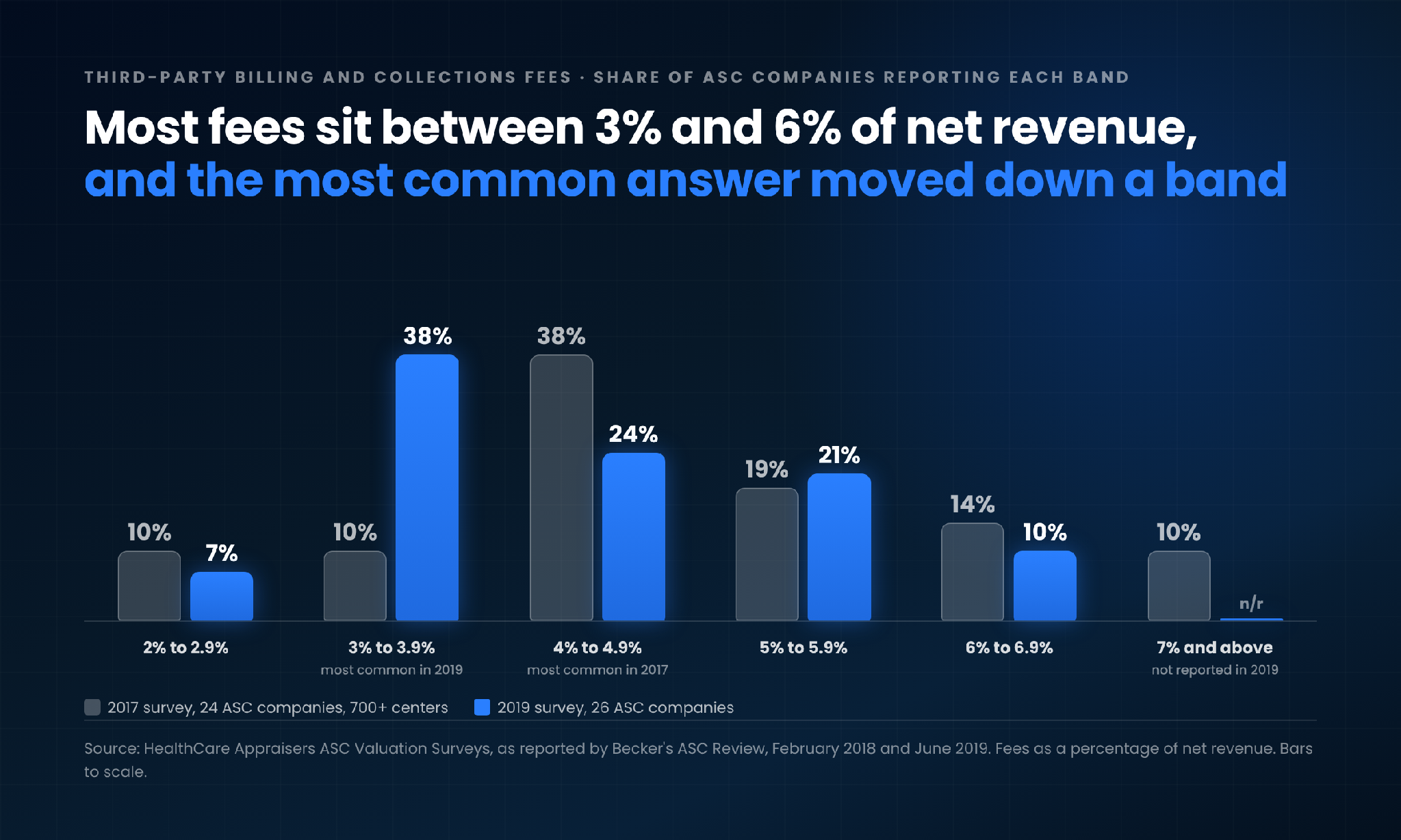
Most surgery centers that outsource billing pay between 3% and 6% of what the billing company collects. In the most recent industry survey to publish the bands, HealthCare Appraisers' 2019 ASC Valuation Survey, compiled with the Ambulatory Surgery Center Association from 26 ASC companies, 38% of respondents reported third-party billing fees of 3.00% to 3.99% of net revenue, 24% reported 4.00% to 4.99%, 21% reported 5.00% to 5.99%, 10% reported 6.00% to 6.99%, and 7% reported 2.00% to 2.99% (Becker's ASC Review, June 2019). The year before, 60% of respondents had reported 4.0% to 5.9% and 40% had reported 3.0% to 3.9% (Becker's ASC Review, April 2018).
That's the range. Where a center lands inside it depends on five things: monthly collections, specialty, what the percentage is charged on, what sits outside the percentage, and whether the biller publishes a rate at all. This page goes through each, with the source and month on every number, and ends with the one surgery-center rate card we know of that's public, which is ours.
The ASC numbers
Facility billing for a surgery center is priced below physician billing. The 2026 guides written for physician practices put full-service billing at 4% to 10% of net collections (Neolytix, September 2026; Helpware, June 2026; GetPracticeHelp, March 2026; MedicalBillersAndCoders, August 2026), or 4% to 9% (OmniMD, January 2026). The ASC surveys sit lower, and the largest benchmarking study sits lower still.
VMG Health's 2018 Multi-Specialty ASC Benchmarking Study, built on 2016 and 2017 data from more than 275 centers, put billing fees on the ASC income statement at a median of 2.8% of net operating revenue, a 75th percentile of 4% and a 90th percentile of 5%. In dollars, the median center paid $204,000 a year in billing fees, the mean $246,000, against mean net operating revenue of $9.9 million (Becker's ASC Review, January 2019). The median ASC in that study is bigger than most independents, which is part of why its percentage is lower: billing percentages fall as collections rise.
The survey bands over time, for the share of ASC companies reporting each:
| Fee as a share of net revenue | 2014 survey | 2017 survey | 2019 survey |
|---|---|---|---|
| 2% to 2.9% | 4% | 10% | 7% |
| 3% to 3.9% | 35% | 10% | 38% |
| 4% to 4.9% | 30% | 38% | 24% |
| 5% to 5.9% | 13% | 19% | 21% |
| 6% to 6.9% | 13% | 14% | 10% |
| 7% and above | 4% | 10% | not reported |
Sources: HealthCare Appraisers ASC Valuation Surveys, as reported by Becker's ASC Review in June 2014, February 2018 and June 2019. The 2017 survey covered 24 ASC companies representing more than 700 centers; the 2019 survey covered 26. No survey since 2019 has published the bands.
Two things to notice. The center of gravity has moved between 3% and 5% for a decade, and in the latest survey the single most common band was 3% to 3.99%. And "net revenue" is the base in every survey, which matters more than the percentage, as the next section explains.
What the percentage is charged on
A 4% fee on gross charges costs more than a 5% fee on net collections, because charges are what you bill and collections are what you keep. One 2026 guide puts it plainly: "A 5% fee applied to gross charges" can cost more than "a 6% fee applied to net collections" (Helpware, June 2026). The ASC surveys above are all on net revenue. When a biller quotes a percentage, the first question is what it's a percentage of.
The second question is whether patient collections are in or out. Some billers charge on insurance collections only and handle patient statements separately; some charge on everything they touch. Expert Medical Billing's tiers, below, are on monthly insurance collections, and the calculator on its site says so in the field label: "Use insurance collections, not total charges" (expertmedicalbilling.co/surgery-centers, October 2026).
How monthly collections move the rate
Every published rate card and every guide agrees on the direction: the percentage falls as volume rises, because the biller's cost per claim falls. The physician-practice guides show it by practice size, with solo practices quoted at 7% to 12% and groups of sixteen or more providers at 3% to 6% (GetPracticeHelp, March 2026). For surgery centers, the clearest version is a rate card by monthly collections.
Expert Medical Billing publishes one: 4.9% of monthly insurance collections up to $50,000 a month, 3.9% from $50,000 to $100,000, 3.5% from $100,000 to $400,000, and 2.9% above $400,000 (expertmedicalbilling.co/surgery-centers, October 2026). On its own calculator's example, a center at roughly $150,000 a month in insurance collections pays 3.5%, which is $5,250 a month, or $63,000 a year.
Put the same center against the survey bands and the difference is visible. At the 2019 survey's most common band, 3% to 3.99%, the annual fee on $1.8 million of collections runs $54,000 to $72,000. At the 2018 survey's majority band, 4% to 5.9%, it runs $72,000 to $106,000. The ranges overlap, and the point isn't that one number is right; it's that the fee on a mid-sized center is a five-figure annual difference between the top and bottom of a band, so the percentage deserves the same negotiation as any other six-figure line.
How specialty moves the rate
Specialty moves the rate through claim complexity and claim value. The 2025 and 2026 guides for physician billing quote orthopedics at 4% to 8% (Medcare MSO, August 2025) or 5% to 9% (GetPracticeHelp, March 2026), anesthesia at 5% to 10% because it's billed on time units (GetPracticeHelp, March 2026), and behavioral health anywhere from 2.5% to 9% depending on volume (Medcare MSO, August 2025; GetPracticeHelp, March 2026). One anesthesia-only biller publishes 3% to 6% of collections for groups, trending lower at higher volume (Luxen Talent, September 2026).
For a surgery center, the specialty effect runs mostly through implants. Orthopedics, spine and ophthalmology carry implant lines that have to be captured, coded to the invoice and paid at the contracted rate, and one billing company notes that these cases bring "greater charge capture and payment challenges" (Medcare MSO, August 2026). One analysis of orthopedic ASC denials puts initial denial rates at 8% to 12% at high-performing centers and 12% to 18% at mid-performing ones, against 5% to 8% at hospitals (Incerto, June 2026). A biller that prices an implant-heavy center at the same rate as a GI center is either very efficient or hasn't looked at the case mix. Ask which.
What sits outside the percentage
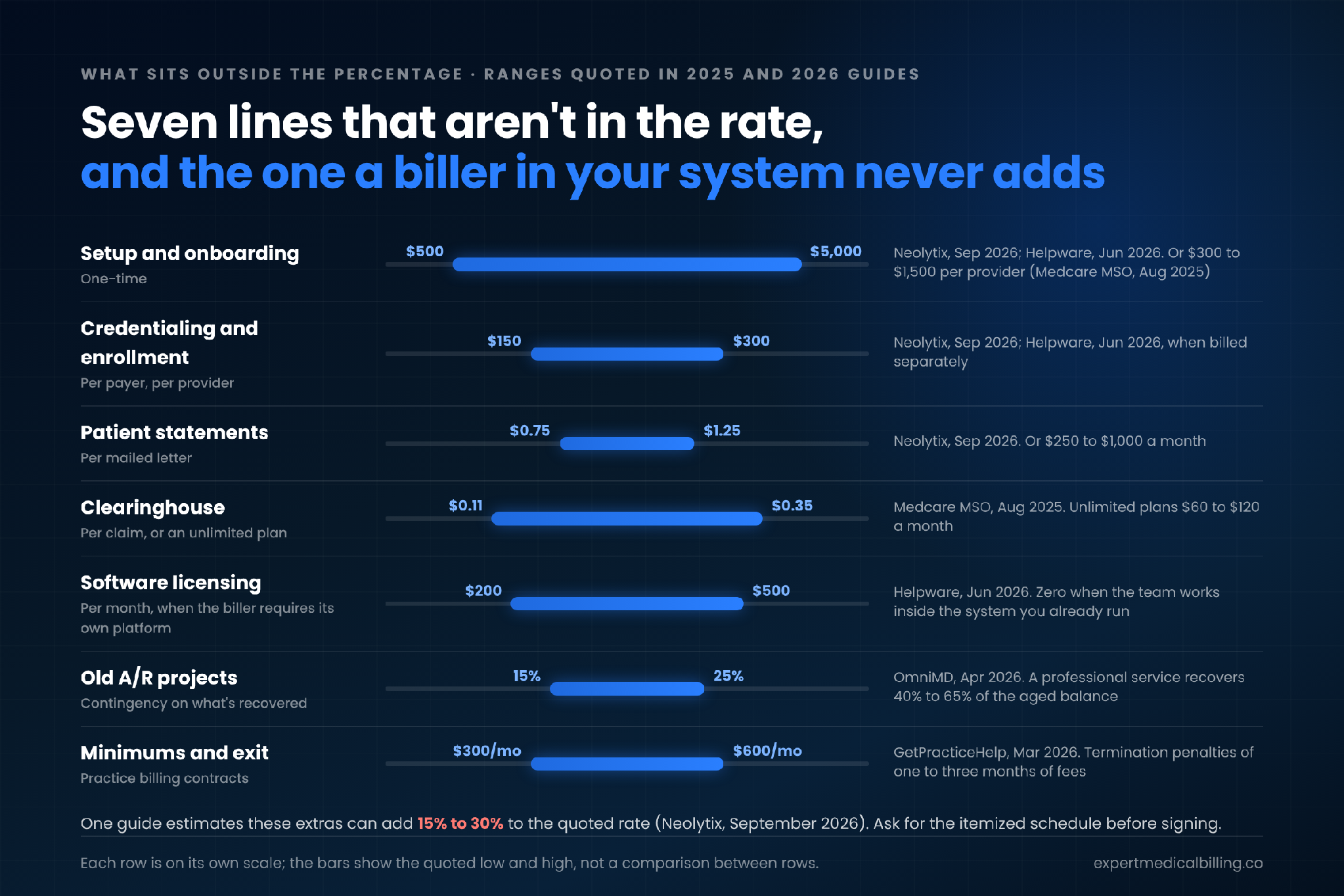
The percentage is rarely the whole bill. Across the 2025 and 2026 guides, the items most often charged separately, with the ranges quoted:
- Setup and onboarding: $500 to $5,000 one-time (Neolytix, September 2026; Helpware, June 2026), or $300 to $1,500 per provider (Medcare MSO, August 2025).
- Credentialing and payer enrollment: $150 to $300 per payer, per provider, when billed separately (Neolytix, September 2026; Helpware, June 2026).
- Patient statements: $0.75 to $1.25 per mailed letter, or $250 to $1,000 a month (Neolytix, September 2026).
- Clearinghouse fees: $0.11 to $0.35 per claim, $0.15 to $0.35 per eligibility check, or unlimited plans at $60 to $120 a month (Medcare MSO, August 2025).
- Software licensing: $200 to $500 a month when the biller requires its own platform (Helpware, June 2026). A biller that works inside your existing practice management system doesn't add this line.
- Old A/R projects: a separate contingency fee, typically 15% to 25% of what's recovered from the aged balance, which a professional service recovers 40% to 65% of (OmniMD, April 2026).
- Monthly minimums and exit terms: minimums of $300 to $600 a month per provider and termination penalties of one to three months of fees appear in practice billing contracts (GetPracticeHelp, March 2026).
One guide estimates that such extras can add 15% to 30% to the quoted rate (Neolytix, September 2026). Ask for the itemized schedule before signing, and ask which of these lines are inside the percentage.
Published rates by named company
Most billing companies quote after a call. These are the ones we found with a rate on a public page, read in October 2026:
| Company | What it publishes | Base | Where |
|---|---|---|---|
| Expert Medical Billing | 4.9%, 3.9%, 3.5%, 2.9% by tier, surgery centers and clinics | Monthly insurance collections | expertmedicalbilling.co/surgery-centers |
| MD Revenue Group | "Typically ranging between 2.99% and 6.5%", ASC page | Net collections | mdrevenuegroup.com |
| Luxen Talent | 3% to 6%, anesthesia groups; no setup or exit fee, month to month | Collections | luxentalent.com |
| SYNERGEN Health (with HST Pathways) | "A significantly reduced percentage of revenue fee", no figure | Revenue | BusinessWire, September 2024 |
| Medcare MSO | No rate of its own; cites an industry range of 3% to 7% | Collections | medcaremso.com |
| nimble solutions, SIS Revenue Cycle Services, Regent RCM, Serbin Medical Billing, Coronis Health | Not published |
Two further rates appear on vendors' own self-ranked lists, 2.49% as a starting rate and a flat 5% of net collections, both for physician practice billing rather than surgery centers; we've left them out of the table because the pages ranking those companies first were written by the companies.
What in-house costs, for comparison
The percentage only means something against what the center pays now. The components, with current public figures: the median annual wage for medical records specialists was $51,140 in May 2025, and for billing and posting clerks $48,500 (U.S. Bureau of Labor Statistics, May 2025). Benefits make up about 30% of total compensation for private-industry workers, which is roughly 43 cents of benefits for every dollar of wages (BLS Employer Costs for Employee Compensation, June 2026). Billing staff turnover runs 25% to 30% a year, with the direct cost of replacing a mid-level biller at $4,000 to $8,000 before they touch a claim and a ramp of 12 to 18 months before a new hire knows the center's payers (Incerto, June 2026). Then software, clearinghouse and the share of the administrator's time spent supervising billing. An older ASC staffing benchmark put the business office at 1.5 FTEs per 1,000 cases (Becker's ASC Review, September 2017).
Expert Medical Billing's surgery-center page carries a calculator that takes those inputs, staff, compensation, burden, supervision, technology and vendor costs, and compares the loaded total against its fee, without asking for contact details. Its own example shows a current loaded cost of $137,500 against a fee of $63,000 (expertmedicalbilling.co/surgery-centers, October 2026). The calculator's own disclaimer applies: it compares operating costs only and doesn't account for differences in collections, A/R performance, underpayments or write-offs. Our page on in-house versus outsourced ASC billing works through those.
The benchmark that ties it together: cost to collect
Whatever the model, the number finance teams use is cost to collect: everything spent on billing, divided by cash collected. The best-practice standard has dropped from 3% to 2% (HFMA, updated November 2022), and 2% to 4% is the commonly cited range, with the industry median around 3% (Magical, accessed October 2026). The one ASC-specific figure published this year comes from KLAS's validation of the HST Pathways and SYNERGEN Health bundle at Compass Surgical Partners' six pilot centers, where cost to collect fell from 3% of net revenue to 2.5% (KLAS, May 2026). An outsourced fee of 2.9% to 3.9% of insurance collections, with nothing outside it, sits inside that benchmark on its own; a quoted 4% plus statements, software and a setup fee may not.
Frequently asked questions
What percentage do billing companies charge surgery centers?
In the latest survey to publish bands, most ASC companies reported 3% to 6% of net revenue, with 3% to 3.99% the single most common answer (HealthCare Appraisers 2019 survey, via Becker's ASC Review, June 2019). The VMG Health benchmarking study put the median ASC's billing fees at 2.8% of net operating revenue (Becker's ASC Review, January 2019).
Is ASC facility billing cheaper than physician billing?
As a percentage, yes. Physician practice guides for 2026 quote 4% to 10% of net collections; the ASC surveys cluster between 3% and 6%, and the larger the center, the lower the rate.
What does Expert Medical Billing charge?
4.9% of monthly insurance collections up to $50,000 a month, 3.9% from $50,000 to $100,000, 3.5% from $100,000 to $400,000, and 2.9% above $400,000. The page says final scope and pricing are confirmed after reviewing the center's revenue cycle and service requirements (expertmedicalbilling.co/surgery-centers, October 2026).
Are there setup fees?
Often. Guides quote $500 to $5,000 one-time or $300 to $1,500 per provider. Ask, because it isn't always on the rate card.
Should we pay per claim instead of a percentage?
Per-claim pricing, $3 to $12 a claim in the 2026 guides, suits high-volume, low-value claims. Surgery center claims are low-volume and high-value, with implants on them, which is why percentage pricing dominates ASC billing. A per-claim biller has no stake in collecting the implant line.
What's a good cost to collect for a surgery center?
The HFMA best-practice standard is 2%, and 2% to 4% is the common range. The one published ASC figure from 2026 is 2.5% of net revenue after a vendor change (KLAS, May 2026).
Why don't most billing companies publish prices?
Because rates vary by collections, specialty, payer mix and scope, and because a quote after a call is easier to hold. The companies above that do publish treat the rate card as a starting point and confirm scope after a review. We think a buyer should be able to read the number before the call, which is why ours is on the page.
How this page was built
Survey data comes from Becker's ASC Review's reporting of HealthCare Appraisers' ASC Valuation Surveys and VMG Health's benchmarking study, cited with their publication months. Rate ranges come from billing companies' and guides' own pages, read on 17 October 2026, and company rate cards from their own sites on the same date. No company paid for inclusion. Corrections go to the address on our contact page.
If you'd like the number for your center rather than the range, book a discovery call. If the question is still whether to outsource at all, the ASC guide at thepracticeoperator.co/asc-billing comes first.
Wondering what this looks like in your center?
A discovery call is a straightforward conversation about where your revenue cycle stands today and who is accountable for it.