
Outsourced billing for HST Pathways surgery centers: independent teams vs HST's bundled RCM
What HST Pathways and SYNERGEN Health publish about the bundled RCM service, what the contract says, and what an independent team inside HST does differently.
November 1, 2026 · 11 min read
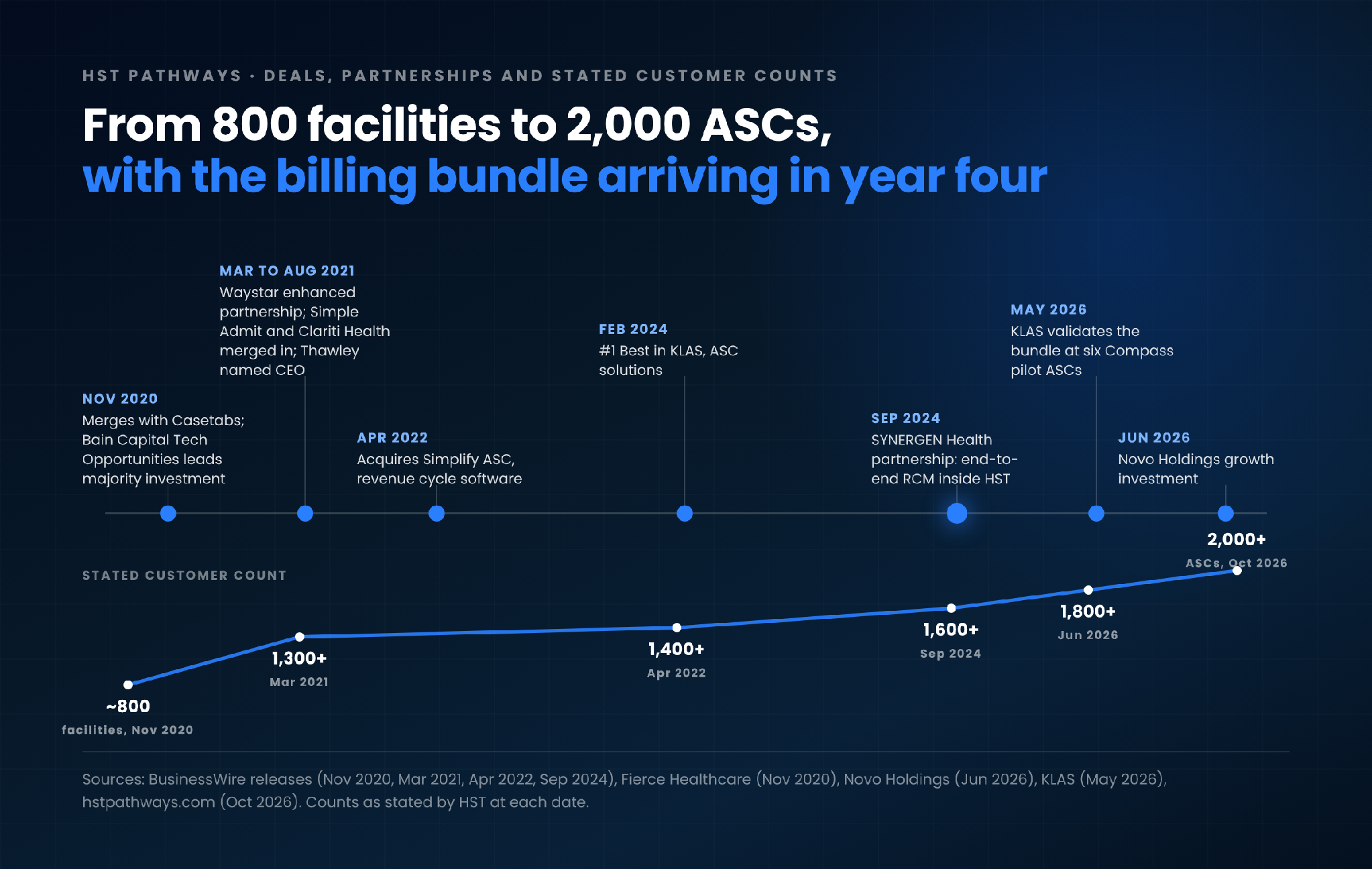
HST Pathways is the practice management system in more than 2,000 surgery centers, by its own count. Its homepage says 2,000 or more ASCs and 75,000 users as of October 2026; the figure was 1,600 when it announced its revenue cycle partnership in September 2024 and 1,800 when Novo Holdings invested in June 2026 (hstpathways.com, October 2026; BusinessWire, September 2024; Novo Holdings, June 2026).
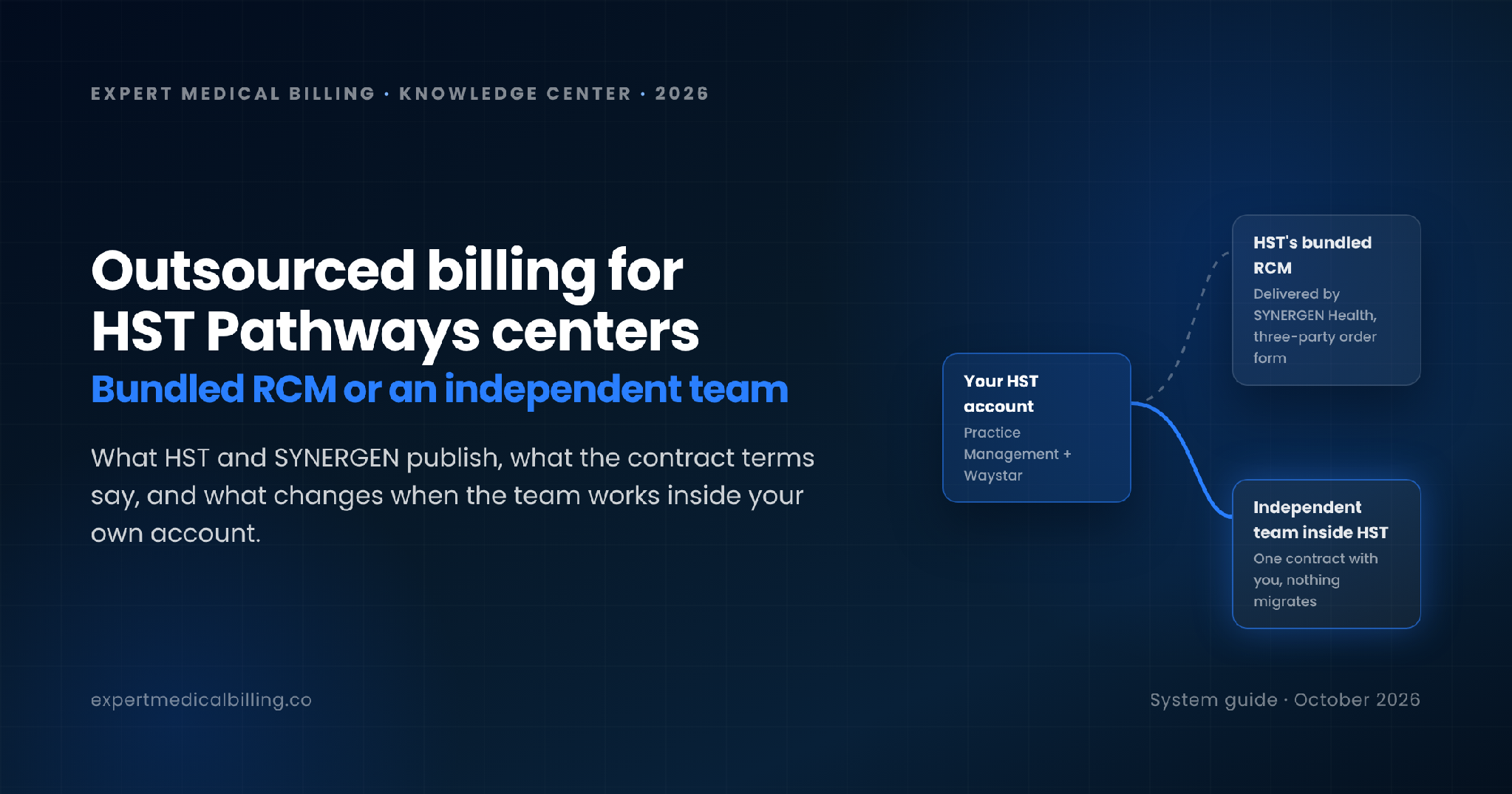
If your center is one of them and you're thinking about outsourcing billing, you have a choice HST centers didn't have two years ago: the vendor's own bundled service, delivered by SYNERGEN Health inside HST, or an independent billing company working inside the same system.
This page is about that choice. Expert Medical Billing is an independent billing company, so read the comparison with that in mind. What follows is what HST and SYNERGEN publish about the bundle, what their contract terms say, what the independent model does differently, and the questions worth settling before signing either.
What HST actually sells
HST's revenue cycle page is headed "ASC RCM Solutions". The page body names no delivery partner, carries no pricing, and the numbers on it are industry benchmarks rather than HST results: days sales outstanding under 42, A/R over 90 days at 17%, collections above 98% of net revenue, bad debt at 2.2%, denials under 5% (hstpathways.com/rcm, October 2026). The partner appears in the footer, in a link to the "HST + SYNERGEN Partnership" terms.
The service itself was announced on 4 September 2024: HST's software with SYNERGEN Health's end-to-end revenue cycle services integrated into it, with SYNERGEN's dashboards inside HST. SYNERGEN was founded in 2011, is based in Dallas, operates in more than 45 states, and was processing over 2 million claims a month at the time, per HST's chief executive (BusinessWire, September 2024).
Its service list for ASCs runs credentialing and contracting, verification and pre-authorization, coding and billing with in-house AAPC-certified coders, claims submission, collections and appeals, denial management, payment posting and reporting (synergenhealth.com, October 2026). Patient collections sit outside the bundle: in the pilot described below, patient-responsibility bad debt was still pending a separate collections vendor contract.
What it costs. The release says SYNERGEN achieves up to 30% lower cost-to-collect and passes the saving on "through a significantly reduced percentage of revenue fee." No figure has been published since, on HST's site, on SYNERGEN's, in the partnership terms, or in the KLAS report (BusinessWire, September 2024; hstpathways.com, October 2026).
What the contract says. The partnership terms, last updated 5 December 2025, are a three-party order form. Fees are paid by the center to HST or to SYNERGEN as applicable, and HST's fees exclude pass-through fees, which cover among other things what HST pays its partners for CPT and ICD codes, with HST reserving the right to increase them. "Deliverables", defined as all work product the service produces, are the exclusive property of SYNERGEN. Each party agrees not to employ the other's covered staff for twelve months after termination (hstpathways.com/terms-conditions/hst-synergen-partnership, December 2025). The term length and the fee live in the order form, which isn't public.
What it has delivered. In May 2026, KLAS published an ROI validation of the bundle at Compass Surgical Partners, based on six pilot ASCs over 120 days. Cost to collect fell from 3% of net revenue to 2.5%. Days in A/R went from 42 to 34. Insurance A/R over 90 days fell from 46% to 35%. Collections as a share of net revenue rose from 71.8% to 90.0%. Days to bill went from 6 to 3. Nine ASCs were live by the end of 2025 with ten more planned for 2026. Project costs were not disclosed one customer organization was interviewed, and the report says it does not represent the vendors' broader customer base (KLAS, May 2026, hosted at hstpathways.com).
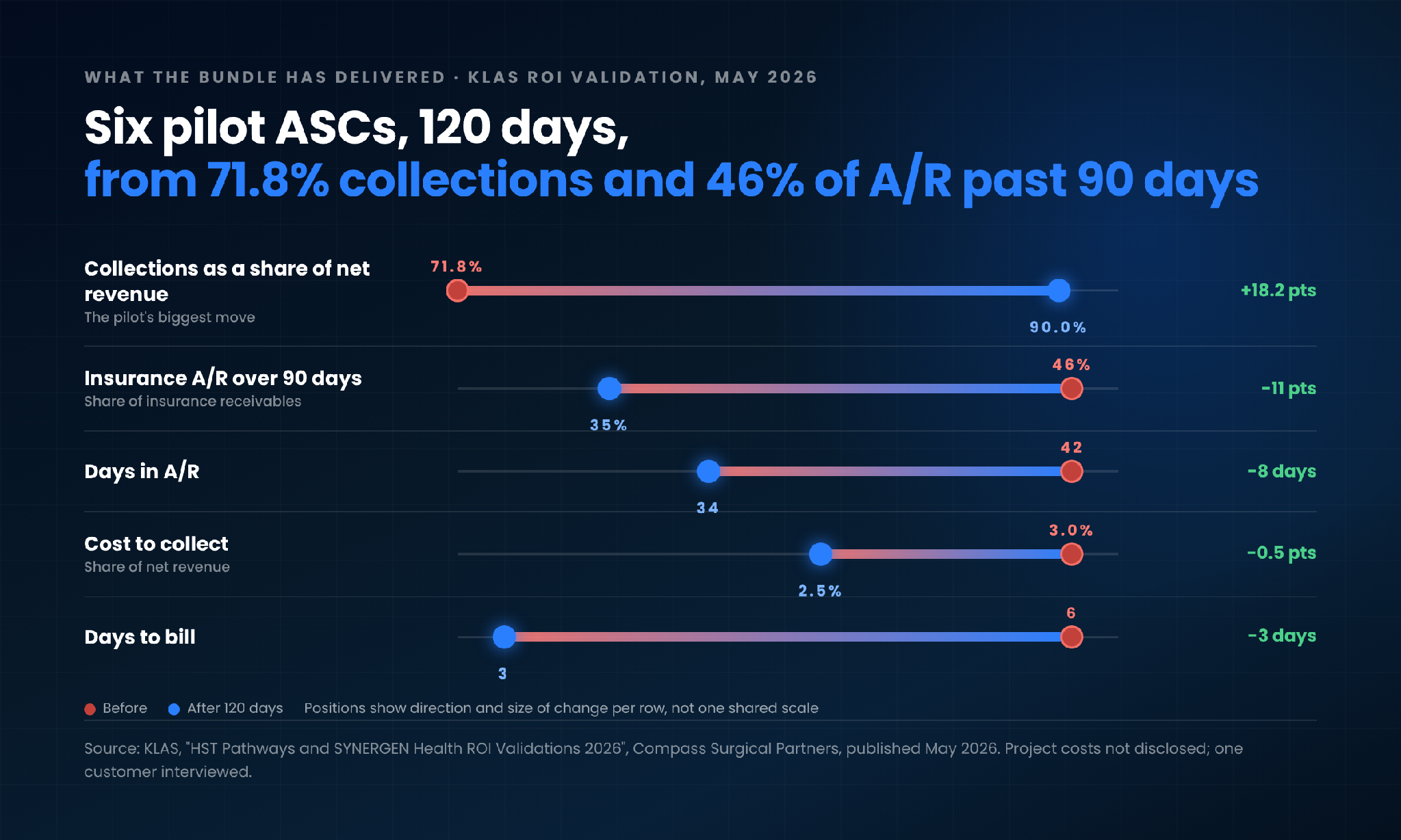
Those are real numbers from a real platform, and they are the best public evidence for the bundle. They're also the numbers of a platform that started at 71.8% collections and 46% of insurance A/R over 90 days. A center starting closer to the benchmarks on HST's own RCM page has less room to move.
The independent model, inside the same system
An independent billing company that works inside HST uses your HST Practice Management, your Waystar connection and your clearinghouse accounts. HST and Waystar have been integrated for well over a decade: one-click eligibility, claim submission from Practice Management to Waystar, automatic remit import and online patient balances, announced as an enhanced partnership in March 2021 after what HST's founder called "nearly a decade" of working together (BusinessWire, March 2021). Nothing about outsourcing changes that plumbing. What changes is who sits at the keyboard.
Three things follow from that.
Your administrator can see the work. Every claim, note and adjustment is in your system, not in a portal that exposes what the vendor chooses. This is an old point in the ASC trade press. In 2012, a SourceMedical executive put it this way about his own billing service: "Our company uses the same software as our clients so they know what we've done" (Becker's ASC Review, May 2012). Caryl Serbin, whose ASC-only billing firm is one of HST's five listed alliance partners, told administrators in 2018 to require "access to your electronic data 24 hours a day, seven days a week, including holidays" (Becker's ASC Review, May 2018).
The software decision and the billing decision stay separate. HST's own partners say this out loud. In May 2026, Nimble Solutions, the largest ASC-focused biller and another HST alliance partner, announced a partnership with Mednet built on what it called a best-of-breed philosophy, "separating software and revenue cycle management functions" to "strengthen accountability across vendors," against "rigid, vertically integrated models that can limit flexibility" (nimblercm.com, May 2026). The executive quoted for Mednet had previously built HST's sales team and then run sales at SYNERGEN.
Leaving is a billing decision, not a software decision. If the independent biller underperforms, you change billers and keep HST. If you ever change software, the biller comes with you.
What HST's terms say about your data
Since the whole question is where the work happens, the data terms matter. HST's standard terms, last updated 21 April 2026, say the customer "is and will remain the sole and exclusive owner of all right, title and interest in and to all Customer Data." They contain no data export or portability provision. On termination, HST disables access to the hosted services; the return and destruction obligations cover HST's materials and confidential information, and HST may retain customer data in its backups until deleted in the ordinary course (hstpathways.com/terms-conditions, April 2026). Raw data export exists as a product, HST Data Stream, which delivers CSV files to an S3 bucket for a center that has its own warehouse (hstpathways.com, October 2026).
None of that is unusual for software terms. It's worth reading before you sign a bundled billing contract, because under the bundle the work product belongs to SYNERGEN and the system belongs to HST. Under the independent model, the work product sits in a system you already have a contract for, in the account you own.
Expert Medical Billing on HST
Expert Medical Billing, or EMB, is a specialized billing department for ambulatory surgery centers and clinics. A dedicated team runs the complete revenue cycle inside the center's own EHR, practice management system and clearinghouse: eligibility checked before the case, certified coding with op notes coded to the implant line, clean claims out the same day, every denial worked rather than filed, payments posted and reconciled daily. Credentialing and enrollment, old A/R recovery and coding audits run as separate services for centers that need them.
On an HST center, that means the team works in HST Practice Management and the Waystar connection the center already runs. Nothing migrates. Anyone at the center can open any claim on any day and see where it stands. Every adjustment carries a name and a reason, and no write-off goes through without the center's sign-off. Front-office staff get direct lines to the team, so a prior authorization question doesn't route through leadership. Thirty days' notice to leave, and the data stays in your systems because it never left them. EMB reports a 98% first-pass clean claim rate and says on its site that it will show you how that number is counted.
Pricing is published by monthly insurance collections: 4.9% up to $50,000 a month, 3.9% from $50,000 to $100,000, 3.5% from $100,000 to $400,000, and 2.9% above $400,000 (expertmedicalbilling.co/surgery-centers, October 2026). Its two published surgery center cases are both ophthalmology ASCs with the numbers taken from the centers' own billing data: at one, receivables over 90 days fell from 30% to 10% of the total in ten months while visit volume grew 45%; at the other, an ASC with an attached clinic that changed billers mid-merger, receivables over 91 days fell from 25% to 14% with no dip through the transition (expertmedicalbilling.co/case-studies, October 2026).
Side by side
| HST's bundled RCM (SYNERGEN) | An independent team inside HST (Expert Medical Billing) | |
|---|---|---|
| Where the work happens | Inside HST, with SYNERGEN's dashboards integrated | Inside your HST and Waystar accounts |
| Who delivers it | SYNERGEN Health, under a three-party order form with HST | The billing company, under one contract with you |
| Pricing you can find | "A significantly reduced percentage of revenue fee"; no figure published | 2.9% to 4.9% of monthly insurance collections, published |
| Who owns the work product | SYNERGEN, per the partnership terms | You; it lives in your system |
| What happens if you change software | Not published | The biller comes with you |
| What happens if you change billers | Not published | You keep HST; thirty days' notice |
| Published results | KLAS validation at one platform: cost to collect 3% to 2.5%, A/R 42 to 34 days, collections 71.8% to 90% of net revenue | Two ASC cases: 90+ day A/R from 30% to 10%, and from 25% to 14% |
| Write-off approval | Not published | Every write-off waits on your sign-off |
| Front-office access | Not published | Direct lines for front-office staff |
Which one fits your situation
You're a multi-site platform standardizing on HST. The bundle's strongest case is yours: one order form, one integration, standardized protocols across centers, and the only KLAS-validated numbers in this market. Ask for the fee as a number, ask what the pass-through fees have run at comparable platforms, and ask who at each center the administrator calls.
You're an independent center and you're happy with HST. You don't need to re-sign anything with your software vendor to outsource billing. An independent team inside HST changes who does the work and nothing else. The questions are the ones on the next section.
You're on HST today but might not be in three years. The independent model keeps the two decisions apart. Under the bundle, ask in writing what happens to the billing relationship if you change software.
You're already in the bundle and the results have been good. Keep it. The pilot numbers are real. Just make sure the write-off process, the front-office access and the exit terms are in your order form rather than assumed.
Questions to settle before you sign either
- What is the fee, as a percentage, and what sits outside it? Under the bundle, ask specifically about pass-through fees.
- Who at the billing company does our front office call, and do they answer to our administrator or to head office?
- Who approves a write-off, and does every adjustment carry a name?
- Can we open any claim ourselves today, in our own HST account?
- If we change software, what happens to the billing relationship?
- If we change billers, how much notice, and what happens to receivables in flight?
- Who owns the work product: the notes, the appeals, the reports?
- What were the starting numbers behind any results you quote, and what are ours?
Frequently asked questions
Does HST Pathways do billing?
HST is software. Its revenue cycle service is delivered by SYNERGEN Health under a partnership announced in September 2024, through a three-party order form between the center, HST and SYNERGEN. HST's own site lists integrations for coding and transcription (Nuance, Vincari) and collections (MNet, TSI) rather than selling those as HST services (hstpathways.com, October 2026).
What does HST's RCM service cost?
No figure is published. The announcement describes a significantly reduced percentage-of-revenue fee; the partnership terms say fees and term are set in the order form. Ask for the number.
Can an outside billing company work inside HST Pathways?
Yes. HST lists billing companies among its alliance and referral partners, including Serbin Medical Billing and Nimble Solutions, and independent billers advertise HST experience. Expert Medical Billing's model is to work inside the center's own practice management system and clearinghouse rather than moving billing to its own platform.
Who owns our data in HST?
Under HST's terms, the customer owns the customer data. The terms don't include an export provision; HST Data Stream is the product for pulling raw data out. Under the SYNERGEN partnership terms, the deliverables the service produces belong to SYNERGEN.
What did the KLAS report find?
At Compass Surgical Partners' six pilot ASCs, cost to collect fell from 3% to 2.5% of net revenue, days in A/R from 42 to 34, insurance A/R over 90 days from 46% to 35%, and collections rose from 71.8% to 90.0% of net revenue over 120 days. Project costs weren't disclosed and one customer was interviewed (KLAS, May 2026).
Is HST still owned by Bain Capital?
Bain Capital Tech Opportunities led the majority investment in November 2020, when HST merged with Casetabs. Novo Holdings made a growth investment in June 2026 alongside Bain Capital and Nexxus Holdings (BusinessWire, November 2020; Novo Holdings, June 2026).
Wondering what this looks like in your center?
A discovery call is a straightforward conversation about where your revenue cycle stands today and who is accountable for it.