
How to Switch ASC Billing Companies: The Transition Period, Week by Week
Switching ASC billing companies, week by week: contract notice, old A/R, payer enrollment, CMS-855B updates, and the numbers to watch in the first 90 days.
November 15, 2026 · 16 min read
The transition period is the stretch between the day a surgery center decides to change billing companies and the day the new arrangement is running at full speed. It is the part of the decision most centers fear, and the reason some stay with an arrangement they have stopped trusting. The fear is specific: a month in which claims go out late, old receivables sit between two teams, and the administrator spends her days on payer portals instead of the OR schedule.
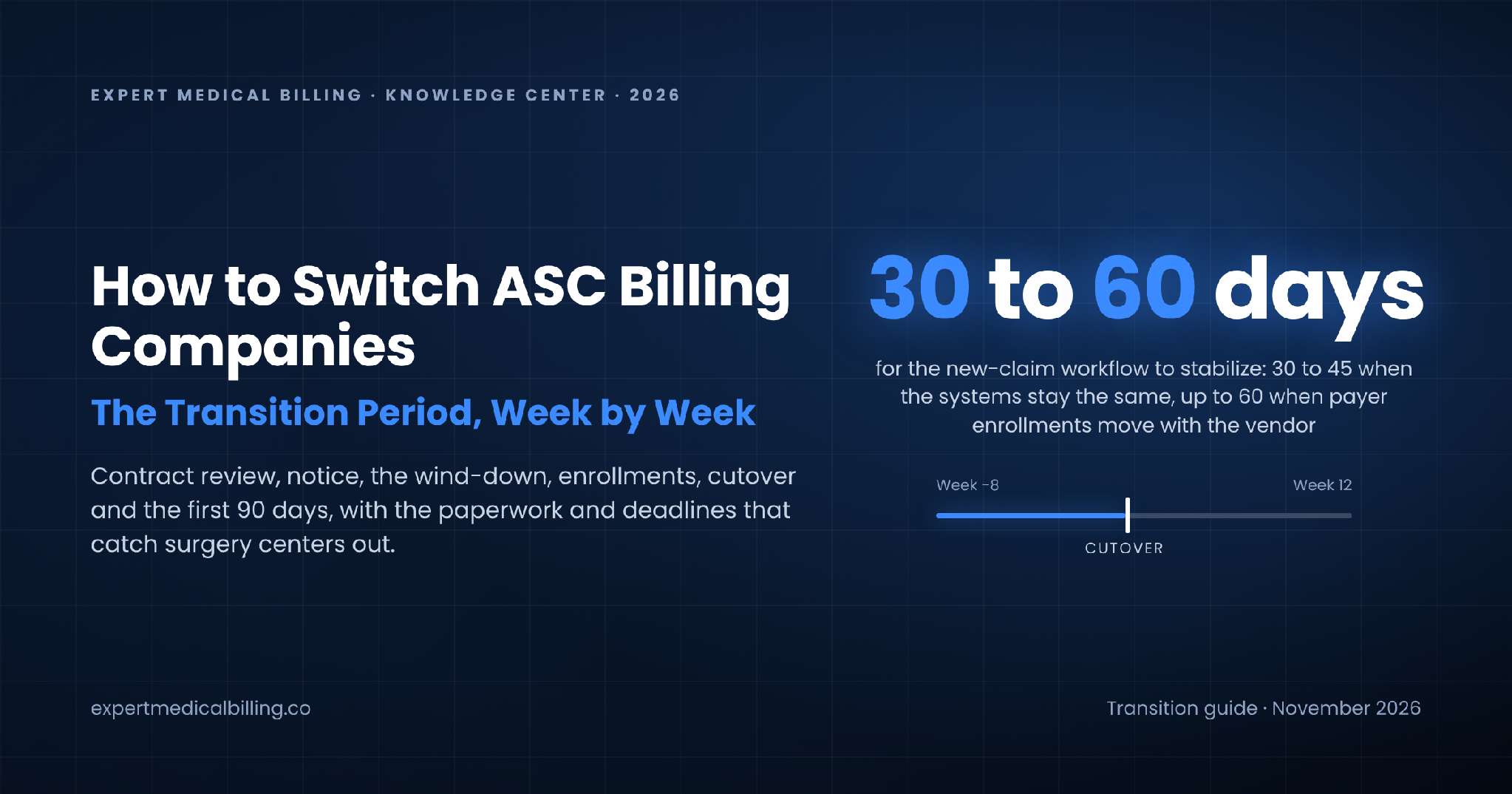
The timeline is shorter and more predictable than that. When the center's systems, bank and payer enrollments stay the same, the new-claim workflow stabilizes in 30 to 45 days. When electronic claim and remittance enrollments have to move with the vendor, that stretches to 30 to 60 days depending on payer approvals, and the cleanup of old receivables runs 60 to 120 days or more depending on how old they are and what the denial mix looks like (Clarity Health RCM, July 2026). This page lays the whole period out week by week, from the contract review eight weeks before cutover to the 90-day review after it, with the paperwork and deadlines that catch centers out, and the one structural choice that decides how much of the list applies to you.
Before you give notice
Weeks minus eight to minus five are spent reading and measuring, and nobody outside the center needs to know.
Read the contract first. Notice periods in billing agreements commonly run 30 to 90 days, and one public agreement analyzed in July 2026 had a three-year initial term with automatic two-year renewals unless notice was given at least 90 days before the term ended (Clarity Health RCM, July 2026). Termination penalties of one to three months of fees appear in practice billing contracts (GetPracticeHelp, March 2026). Find the notice clause, the renewal date, any penalty, and the clause that says what happens to claims with dates of service before termination. One agreement required a 120-day wind-down for pre-termination A/R before the vendor stopped working it (Clarity Health RCM, July 2026). If your contract is silent on the wind-down, that is the first thing to negotiate when you give notice.
Pull the baseline while the current vendor is still producing reports. Twelve months of collections by month and by payer, the A/R aging by payer with the share over 90 days, days in A/R, first-pass acceptance rate, denial rate and the top denial reasons, unbilled encounters, and credit balances. You will measure the transition against these numbers, and you will want them from before the notice went in.
Inventory the systems and who owns the logins. The EHR and practice management system, the clearinghouse account, each payer portal, the bank and lockbox, the statement vendor, and the fax or document platform. Write down for each one whether the account is in the center's name or the vendor's. This list decides how much of the rest of this page applies to you.
Decide what happens to old receivables. There are three options. The outgoing vendor works claims with dates of service before cutover through a wind-down period, for its normal fee. The incoming team takes them over, usually as a separate old-A/R project at a contingency fee of 15% to 25% of what is recovered, with a professional service recovering 40% to 65% of the aged balance (OmniMD, April 2026). Or the center works them in-house. The right answer depends on the age of the balance and on how the contract reads, and it should be settled before notice goes in rather than after.
Giving notice and choosing the structure
Weeks minus four and minus three. Give notice in writing, in the form the contract requires, and get the wind-down terms in writing with it: who works pre-cutover claims and for how long, how often you get a status report on them (a sample clause suggests every two weeks), when the final reports arrive (within 30 days is a reasonable ask), and how and when your data comes back (OmniMD, September 2026; Clarity Health RCM, July 2026). The business associate agreement already covers the last point. The sample provisions published by the U.S. Department of Health and Human Services require a business associate, at termination and where feasible, to return or destroy all protected health information it received or created on the covered entity's behalf, to retain no copies, and they make that obligation survive the termination of the agreement (HHS, Business Associate Contracts, January 2013). Ask for the return in your systems' format and the destruction in writing.
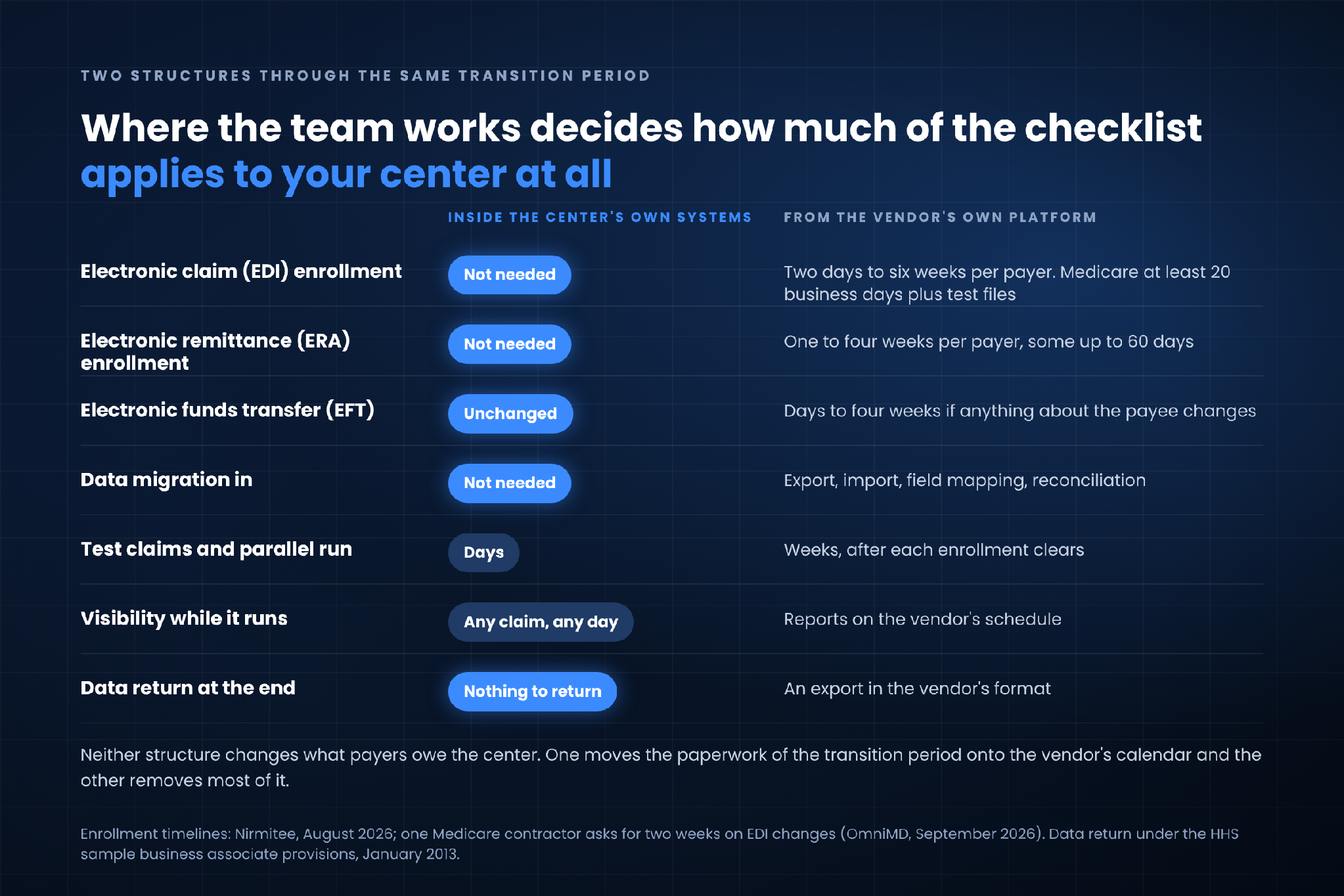
Then choose the structure of the new arrangement, because everything in the following weeks depends on it. A billing company works in one of two places. Either its team logs into the center's own EHR, practice management system and clearinghouse and does the work there, or it moves the center's charges into its own platform, submits through its own clearinghouse and sends reports back. The second structure is not wrong, and large vendors run it well. It does add a set of steps to the transition period that the first structure never needs: electronic claim, remittance and payment enrollments with every payer, a data migration on the way in, and a data export on the way out. The two structures are compared side by side further down this page.
Sign the new agreement and the new business associate agreement in the same week, and read the new contract's exit clause with the same attention you gave the old one. The fairest test of a billing company is how it behaves in the month you leave, and the clause tells you in advance.
The transition period, week by week
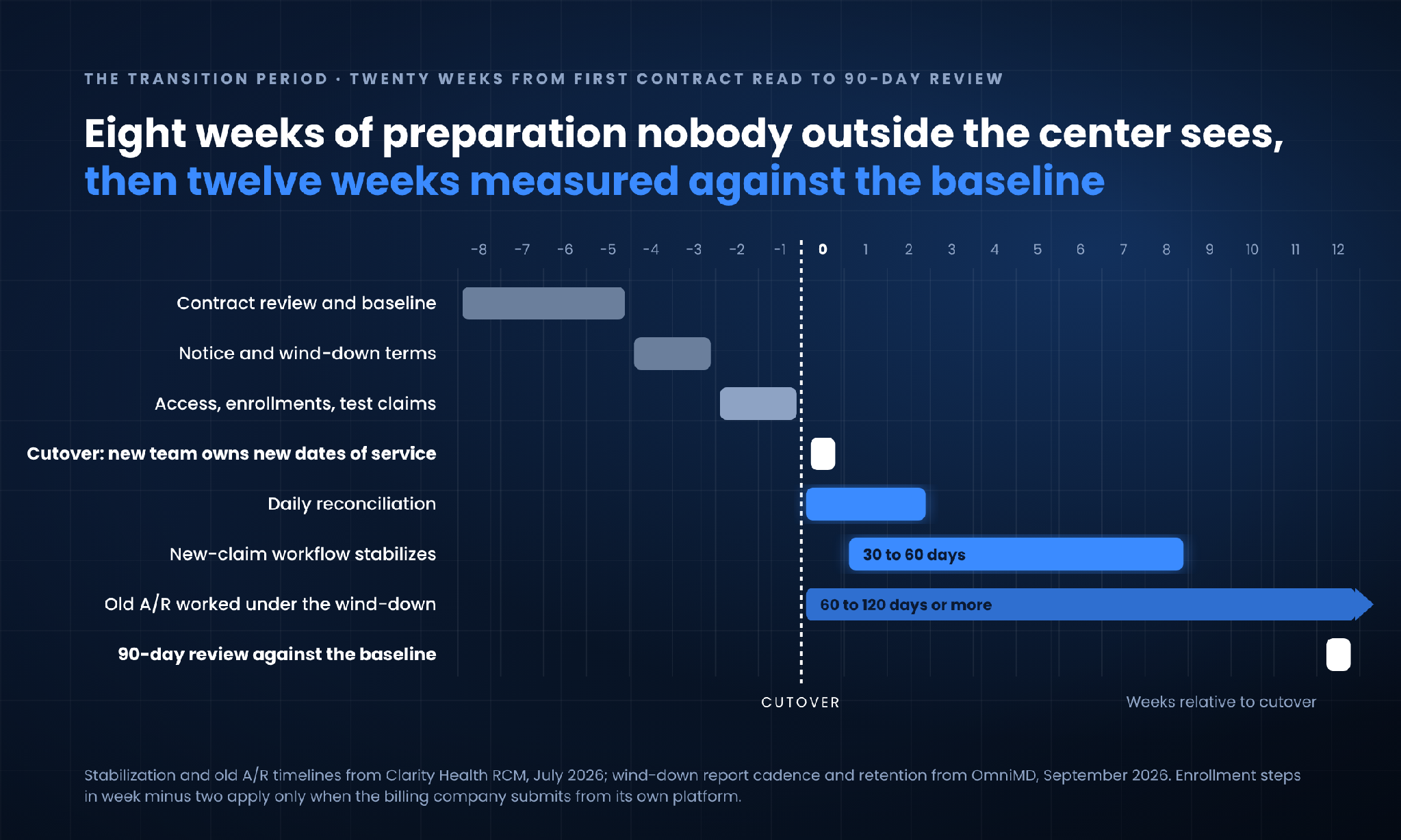
Week zero is cutover: the first date of service the new team owns. Everything before it is preparation, and the weeks after it are measured against the baseline you pulled before notice.
| Weeks | What happens | Who carries it | What to check |
|---|---|---|---|
| Minus 8 to minus 5 | Contract review: notice clause, renewal date, penalties, wind-down. Baseline pulled: collections by month and payer, A/R aging, days in A/R, first-pass acceptance, denial rate, unbilled, credit balances. Systems and logins inventoried. Old A/R plan decided. | Administrator, with the center's accountant | Every account named as the center's or the vendor's |
| Minus 4 to minus 3 | Written notice. Wind-down terms agreed: pre-cutover claims, report cadence, final reports, data return under the BAA. Structure chosen. New agreement and BAA signed. | Administrator, governing board where required | Exit clause of the new contract read before signing |
| Minus 2 to minus 1 | Access provisioned: user accounts in the EHR and practice management system, the clearinghouse, payer portals. Write-off authority, coding query path and report format agreed. Front office told who to call. If the vendor uses its own platform: EDI, ERA and EFT enrollments filed with every payer, data migration mapped, test claims sent to the highest-volume payers. CMS-855B Section 8 update prepared. | New billing team, with the center's IT or EHR vendor | Rejections on test claims cleared before cutover |
| Week 0 | Cutover. New team owns dates of service from day one. Outgoing vendor keeps pre-cutover claims under the wind-down. Eligibility run on everything scheduled. Charges in, claims out, rejections and deposits reconciled daily. | New billing team, front office, administrator | Every charge from day one has a claim or a reason |
| Weeks 1 to 2 | Daily reconciliation continues. Rejections cleared within 48 hours. Unbilled encounters older than five business days flagged. Old claims within 30 to 45 days of a timely filing or appeal deadline put on a red list and worked first. | New billing team | Rejection age, unbilled age, red list count |
| Weeks 3 to 6 | First remittances post on new claims. Payment posting lag measured. First-pass acceptance baseline set. Denials from new claims categorized by reason. Wind-down status report from the outgoing vendor every two weeks. Credit balances reviewed. | New billing team, administrator | First-pass acceptance against the pre-notice baseline |
| Weeks 7 to 12 | New-claim workflow steady: by day 30 to 45 when systems stayed the same, by day 30 to 60 when enrollments moved. Old A/R cleanup continues to day 60 to 120 or more. Wind-down ends and final reports arrive. Data return or destruction confirmed in writing. Closed-claim exports kept for at least six years. Portal and system access for the outgoing vendor removed. 90-day review against the baseline. | Administrator, new billing team, outgoing vendor | A/R over 90 days, days in A/R, denial rate against baseline |
Timelines in the table are from Clarity Health RCM (July 2026) for stabilization and old A/R cleanup, OmniMD (September 2026) for the report cadence and the six-year retention of closed-claim exports, and Clarity Health RCM (July 2026) for the 48-hour, five-business-day and 30-to-45-day thresholds, which it publishes as examples of a transition red list.
Two structures through the same twelve weeks
The table above is the long version. How much of it applies depends on where the new team works.
| Step in the transition period | Team works inside the center's own systems | Team works from the vendor's own platform |
|---|---|---|
| Electronic claim (EDI) enrollment | None. The center's clearinghouse account and submitter ID are unchanged. | Filed with each payer. Two days to two weeks through payer portals, two to six weeks by form or fax, and Medicare needs at least 20 business days plus test files (Nirmitee, August 2026). |
| Electronic remittance (ERA) enrollment | None. Remittances keep arriving where they arrive today. | One to four weeks per payer, with some payers taking up to 60 days (Nirmitee, August 2026). One Medicare contractor asks practices to allow two weeks for EDI enrollment changes (OmniMD, September 2026). |
| Electronic funds transfer (EFT) | None. Payments were always to the center's bank. | Days to four weeks if anything about the payee changes (Nirmitee, August 2026). Payments should stay with the center's bank account in either structure. |
| Data migration in | None. The charges, claims and history are already in the system the team logs into. | Export from the old platform, import and field mapping into the new one, and a reconciliation of what moved. |
| Test claims and parallel run | Test claims to the highest-volume payers in the week before cutover. | Test claims after each enrollment clears, with a claim hold or the old route kept live until it does. One analysis uses a three-business-day hold as an example (Clarity Health RCM, July 2026). |
| Visibility during the transition period | Anyone at the center can open any claim on any day and see where it stands. | Reports on the vendor's schedule, with the detail the platform exposes. |
| Timely filing exposure | Limited to the old A/R plan. New claims go out the same way, from day one. | Every week an enrollment waits is a week of claims held or routed the old way. Medicare's limit is one calendar year from the date of service; Medicaid programs cap at 12 months with some states shorter; commercial plan limits vary by contract, with 180 calendar days a common figure and corrected-claim windows as short as 60 days (OmniMD, September 2026; Clarity Health RCM, July 2026). |
| Data return at the end | Nothing to return. The data never left the center's systems. | An export in the vendor's format under the BAA, to be mapped back into whatever comes next. |
Neither structure changes what the center owes the payers or what the payers owe the center. One of them moves the paperwork of the transition period from the center's calendar to the vendor's, and the other removes most of it.
What to watch in the first 90 days
Reconcile daily in the first week: charges in, claims out, rejections, deposits. After that, a weekly report with seven numbers tells the administrator whether the transition is on track, and all seven come from one July 2026 transition guide's red-list thresholds and the baseline you pulled before notice (Clarity Health RCM, July 2026).
- Claim acceptance rate at the clearinghouse and the payer, against the pre-notice first-pass rate.
- Rejections older than 48 hours. The number should be zero most weeks.
- Unbilled encounters older than five business days.
- Claims on the timely filing red list: anything within 30 to 45 days of a filing or appeal deadline.
- Denials by reason and by age, so the first new denial pattern is visible in week three rather than week ten.
- Share of A/R over 90 days, split between pre-cutover claims under the wind-down and new claims.
- Payment posting lag and credit balances.
The split in the sixth number matters. In the first 90 days, A/R over 90 days will contain the old vendor's tail and the new team's work in one figure. Report them separately or the wind-down's performance and the new arrangement's performance will blur into each other, and whichever looks worse will get blamed for both.
The paperwork nobody mentions
Medicare enrollment. An ambulatory surgical center enrolls with Medicare on the CMS-855B, and Section 8 of that form records the billing agency. Suppliers other than physician organizations must report changes of ownership or control within 30 days and all other changes to their enrollment within 90 days (42 CFR 424.516(e)). A change of billing agency is one of the other changes. Put the update on the week-minus-one list so it goes in with the cutover rather than ninety days after it.
Payer enrollments. Electronic claim, remittance and payment enrollments attach to the center's tax ID and national provider identifier and to the submitter that sends the claims. If the submitter stays the same, nothing re-enrolls. If it changes, the timelines in the comparison table apply payer by payer, and the longest one sets the date the last payer goes live.
Payer portals. Most portals allow delegated users under the center's account. Add the new team's users in week minus two and remove the outgoing vendor's users on cutover for new claims and at the end of the wind-down for old ones. A portal login that belongs to a vendor's employee rather than to the center is a login the center cannot revoke.
The bank. Payments go to the center's account in every structure, and nothing about a change of billing company should touch the payee on an EFT enrollment. If a proposal asks to route payments through the vendor's account, that is a different kind of arrangement and deserves its own review.
The business associate agreement. The HHS sample provisions above cover return or destruction at termination. Get the confirmation in writing, with the date, and keep it with the closed-claim exports for at least six years, which is the retention period one September 2026 guide recommends and the lookback period for Medicare overpayments (OmniMD, September 2026).
Appeals in flight. A Medicare redetermination is due within 120 days of receiving the denial notice, with receipt presumed five days after the printed date, and the contractor then has 60 days to decide (OmniMD, September 2026). Any appeal the outgoing vendor filed has a clock on it. List them at notice, with the dates, and assign each one an owner for the wind-down.
How Expert Medical Billing runs the transition period
Expert Medical Billing, or EMB, is a specialized billing department for ambulatory surgery centers and clinics. A dedicated team runs the complete revenue cycle inside the center's own EHR, practice management system and clearinghouse: eligibility checked before the case, certified coding with op notes coded to the implant line, clean claims out the same day, every denial worked rather than filed, payments posted and reconciled daily. Credentialing and enrollment, old A/R recovery and coding audits run as separate services for centers that need them.
Where the work happens: in your systems. That is the first column of the comparison table above. There is no data migration in, no payer re-enrollment, and no export out, because the team logs into what the center already runs. Anyone at the center can open any claim on any day and see where it stands. Every adjustment carries a name and a reason, and no write-off goes through without the center's sign-off. EMB reports a 98% first-pass clean claim rate and says on its site that it will show you how that number is counted (expertmedicalbilling.co, October 2026).
Who you can reach: a named team, with direct lines for front-office staff, so a prior authorization question during the transition period does not have to route through leadership to get an answer.
What leaving costs: thirty days' notice. The data stays in your systems because it never left them. The exit clause is the same on the way out as it was on the way in.
Proof from a transition that happened at the worst possible time: an ophthalmology ASC with an attached clinic and five providers changed billers in the middle of a merger, the moment claims usually fall between teams. There was no dip in performance through the transition; receivables over 91 days fell from 25% to 14%, and the ASC and clinic collected $4.35 million in 2025 (expertmedicalbilling.co/case-studies, October 2026). The numbers are the center's own, published with the case.
Pricing: published, by monthly insurance collections. 4.9% up to $50,000 a month, 3.9% from $50,000 to $100,000, 3.5% from $100,000 to $400,000, and 2.9% above $400,000 (expertmedicalbilling.co/surgery-centers, October 2026).
Frequently asked questions
How long does it take to switch billing companies?
When the center's systems, bank and payer enrollments stay the same, the new-claim workflow stabilizes in 30 to 45 days. When electronic claim and remittance enrollments move with the vendor, 30 to 60 days depending on payer approvals. Old receivables take 60 to 120 days or more to clean up (Clarity Health RCM, July 2026). Plan eight weeks of preparation before cutover and a 90-day review after it.
How much notice do we have to give?
Read the contract. Notice periods commonly run 30 to 90 days, some agreements renew automatically unless notice is given 90 days before the term ends (Clarity Health RCM, July 2026), and termination penalties of one to three months of fees appear in practice billing contracts (GetPracticeHelp, March 2026). Expert Medical Billing's own term is thirty days' notice.
Who works the old claims?
One of three parties: the outgoing vendor through a wind-down period, which one public agreement set at 120 days (Clarity Health RCM, July 2026); the incoming team as an old-A/R project, usually at 15% to 25% of what is recovered (OmniMD, April 2026); or the center itself. Decide before notice goes in.
Will we lose revenue during the transition period?
The exposure is timely filing on claims nobody owns. Medicare allows one calendar year from the date of service, Medicaid up to 12 months with some states shorter, and commercial plan limits vary by contract, with 180 calendar days a common figure (OmniMD, September 2026; Clarity Health RCM, July 2026). A red list of claims within 30 to 45 days of a deadline, worked first, is how the exposure is managed. A structure that needs no payer re-enrollment removes the other source of delay.
Do we have to re-enroll with every payer?
Only if the submitter changes. Enrollments attach to the center's tax ID, NPI and the clearinghouse submitter. A team that works inside the center's own clearinghouse account changes nothing. A vendor that submits from its own platform re-enrolls payer by payer, at two days to six weeks each, with Medicare needing at least 20 business days plus test files (Nirmitee, August 2026).
What has to be reported to Medicare?
A change of billing agency goes on the CMS-855B, Section 8, and suppliers must report changes other than ownership and control within 90 days (42 CFR 424.516(e)).
What happens to our data when we leave a billing company?
Under the HHS sample business associate provisions, the vendor returns or destroys all protected health information at termination where feasible and retains no copies, and the obligation survives the agreement (HHS, January 2013). Ask for the return in your systems' format and the destruction in writing. When the work was done inside the center's own systems, there is nothing to return.
How this article was built
Transition timelines, notice terms and red-list thresholds come from billing companies' and guides' own pages published in 2026, cited with their publication months and read on 9 November 2026. Enrollment timelines come from an August 2026 claims-integration guide and a September 2026 guide citing a Medicare contractor's own instruction. Regulatory points are from the Code of Federal Regulations and the U.S. Department of Health and Human Services' published sample business associate provisions. The week-by-week table is our construction from those sources and from running transitions for surgery centers; where a threshold is one guide's example rather than a rule, the page says so. No company paid for inclusion. Corrections go to the address on our contact page.
If you are inside a notice period now, or about to be, book a discovery call and bring the contract and twelve months of A/R aging. If the question is still whether to outsource at all, the ASC guide at thepracticeoperator.co/asc-billing comes first, and the cost comparison in this series comes second.
Wondering what this looks like in your center?
A discovery call is a straightforward conversation about where your revenue cycle stands today and who is accountable for it.